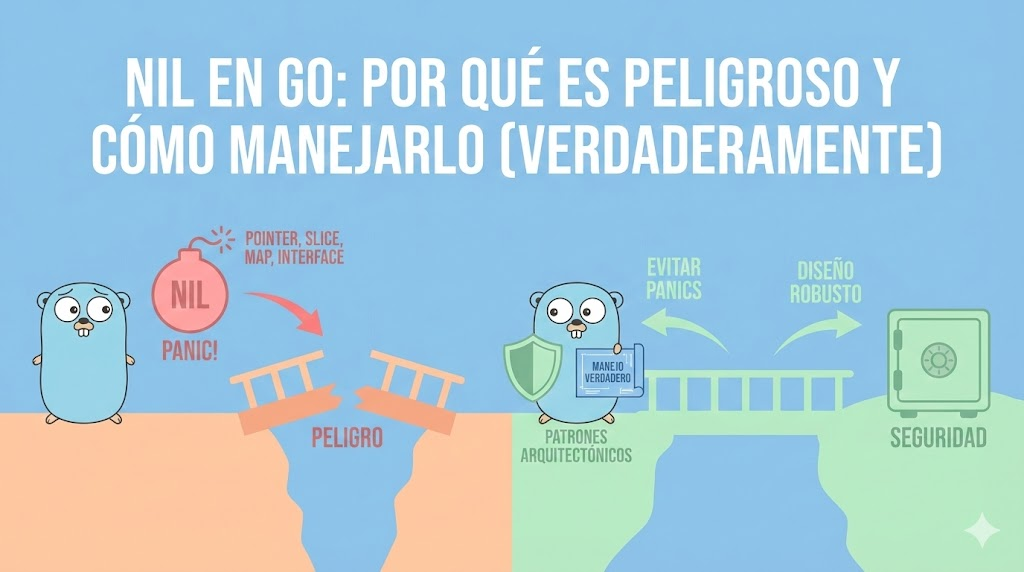
Nil en Go: Por Qué Es Peligroso y Cómo Manejarlo (Verdaderamente)
Una exploración exhaustiva sobre nil en Go: qué es, por qué causa tantos bugs, cómo afecta arquitectura, patrones para evitarlo, y cómo diseñar APIs que minimicen nil errors. Con 40+ ejemplos de código y anti-patrones reales.
Go es famoso por su manejo de errores explícito. Nadie duda de eso. Pero hay un error que Go permite silenciosamente: nil.
Un pointer nil. Un slice nil. Una interfaz con receiver nil. Un map nil. Cada uno de estos puede causar un panic en runtime que no es detectado en tiempo de compilación.
La mayoría de los lenguajes modernos han intentado resolver esto. Rust tiene Option<T>. Kotlin tiene tipos nullable explícitos. TypeScript tiene null y undefined con type checking. Todos ellos reconocen que nil/null es peligroso y que merece atención especial en el sistema de tipos.
Go no hizo nada de esto. Go dejó que nil fuera completamente implicit. Un pointer puede ser nil sin que el compilador te avise. Una función puede devolver algo que es nil sin que sea evidente del tipo. Un método puede ser llamado en un receiver nil que causará panic.
Tony Hoare, quien inventó null, lo llamó “The Billion Dollar Mistake”. Go decidió no aprender esa lección.
Pero Go lo compensó de otras formas. No con type safety (como Rust), sino con patrones arquitectónicos sensatos que minimizan el daño de nil y hacen que los nil errors sean raros y predecibles.
El problema es que la mayoría de los equipos de Go no usan esos patrones. Así que terminan con código lleno de nil checks, nil panics, y arquitectura frágil alrededor de nil.
Este artículo es una exploración exhaustiva y práctica sobre nil en Go: qué es, por qué es tan peligroso, qué patrones arquitectónicos lo minimizan, cómo diseñar APIs que eviten nil, y cómo manejar nil elegantemente cuando es inevitable.
Parte 1: Qué Es Nil, Realmente
1.1 La Definición Simple (Que Es Insuficiente)
Nil es el “valor cero” para pointers, interfaces, slices, maps, y channels. Es la ausencia de valor.
var p *int        // nil
var i interface{}  // nil
var s []int        // nil
var m map[string]int  // nil
var c chan int     // nil
Eso es técnicamente correcto. Pero es incompleto.
1.2 Lo Que Realmente Significa
Nil significa diferentes cosas dependiendo del tipo:
Para pointers:
var p *User  // nil = "no hay User"
var p2 *User = &User{}  // no-nil = "hay un User"
Para slices:
var s []int  // nil = "no hay elementos, capacidad 0, ninguno asignado"
var s2 []int = make([]int, 0)  // no-nil pero vacío = "hay un slice, pero cero elementos"

// Son diferentes:
len(s) == 0   // true
cap(s) == 0   // true
s == nil      // true

len(s2) == 0  // true
cap(s2) == 0  // true
s2 == nil     // false
Para maps:
var m map[string]int  // nil = "no hay map"
var m2 map[string]int = make(map[string]int)  // no-nil = "hay un map vacío"

// Son diferentes:
len(m) == 0   // true (pero panic si lees)
m == nil      // true

len(m2) == 0  // true
m2 == nil     // false

// Leer de nil map = panic
value := m["key"]  // ❌ panic: assignment to entry in nil map
value := m2["key"]  // ✅ OK, devuelve valor cero
Para interfaces:
var i interface{}  // nil = "interfaz sin valor ni tipo"
var i2 interface{} = (*User)(nil)  // no-nil = "interfaz con tipo *User, pero valor nil"

// Son diferentes:
i == nil   // true
i2 == nil  // false (!)

// i2 es una "interfaz de nil". Diferente a nil.
1.3 El Problema: Nil No Es Un Error Explícito
En Go, un función puede devolver nil sin que sea evidente:
func GetUser(id string) *User {
    if id == "" {
        return nil  // ← nil implícito
    }
    return &User{ID: id}
}

user := GetUser("")
fmt.Println(user.Name)  // ❌ panic: nil pointer dereference
El compilador no se queja. Devolviste nil. El usuario lo recibió. El usuario lo dereferenció. Panic.
Compara con Rust:
fn get_user(id: &str) -> Option<User> {
    if id.is_empty() {
        return None;  // Explícito
    }
    Some(User { id: id.to_string() })
}

let user = get_user("");
// Rust: Error! No puedes acceder a fields de Option sin unwrap
println!("{}", user.name);  // ❌ Compilation error
Rust te obliga a manejar el caso de “ausencia de valor”. Go te deja que lo ignores.
Parte 2: Por Qué Nil Es Tan Peligroso
2.1 Problema #1: Nil Panics son Impredecibles
// ❌ INCORRECTO: Nil puede venir de cualquier lado
func ProcessOrder(order *Order) {
    // order puede ser nil
    // ¿Dónde vinieron? ¿De dónde?
    // No hay forma de saberlo en tiempo de compilación

    total := order.CalculateTotal()  // ❌ panic si order es nil
}

func main() {
    order := getOrderFromDB()  // Puede devolver nil
    ProcessOrder(order)  // Panic no predicho
}
El problema:
- No hay forma de saber si una función puede devolver nil
- No hay forma de saber si una función acepta nil
- El panic puede venir de cualquier lugar
- Es un error runtime, no compiletime
// ✅ MEJOR: Explícito sobre nil
func ProcessOrder(order *Order) error {
    if order == nil {
        return ErrNilOrder
    }

    total := order.CalculateTotal()
    return nil
}

// O mejor aún: No acepta nil
type Order struct { ... }

func ProcessOrder(order Order) error {
    // order NUNCA puede ser nil
    // No es un pointer
    total := order.CalculateTotal()
    return nil
}
2.2 Problema #2: Nil Checks Verbosos
// ❌ INCORRECTO: Demasiados nil checks
func GetUserProfile(userID string) (*Profile, error) {
    user, err := getUser(userID)
    if err != nil {
        return nil, err
    }
    if user == nil {  // ← Nil check
        return nil, ErrUserNotFound
    }

    preferences, err := getPreferences(user.ID)
    if err != nil {
        return nil, err
    }
    if preferences == nil {  // ← Nil check
        return nil, ErrPreferencesNotFound
    }

    settings, err := getSettings(user.ID)
    if err != nil {
        return nil, err
    }
    if settings == nil {  // ← Nil check
        return nil, ErrSettingsNotFound
    }

    return &Profile{
        User:        user,
        Preferences: preferences,
        Settings:    settings,
    }, nil
}
El 50% del código es nil checks. Es verboso y repetitivo.
// ✅ MEJOR: No devolver nil cuando se puede evitar
func GetUser(userID string) (User, error) {
    // Devuelve User (no *User), nunca nil
    // O devuelve error
    ...
}

func GetUserProfile(userID string) (Profile, error) {
    user, err := GetUser(userID)
    if err != nil {
        return Profile{}, err
    }

    preferences, err := getPreferences(user.ID)
    if err != nil {
        return Profile{}, err
    }

    settings, err := getSettings(user.ID)
    if err != nil {
        return Profile{}, err
    }

    return Profile{
        User:        user,
        Preferences: preferences,
        Settings:    settings,
    }, nil
}
Mismo código, pero sin nil checks. Más limpio.
2.3 Problema #3: Semántica Confusa
// ❌ INCORRECTO: ¿Qué significa nil?
func FindOrder(id string) *Order {
    order := &Order{}
    rows := db.Query("SELECT * FROM orders WHERE id = ?", id)

    if !rows.Next() {
        return nil  // ← ¿Significa "no encontrado" o "error"?
    }

    rows.Scan(&order.ID, &order.UserID, &order.Total)
    return order
}

// Cuando llamas:
order := FindOrder("123")
if order == nil {
    fmt.Println("Not found or error?")  // Ambiguo
}
¿Nil significa “no encontrado” o “error en BD” o “error de parsing”? No está claro.
// ✅ MEJOR: Semántica clara
func FindOrder(id string) (Order, error) {
    var order Order
    row := db.QueryRow("SELECT * FROM orders WHERE id = ? LIMIT 1", id)

    err := row.Scan(&order.ID, &order.UserID, &order.Total)
    if err == sql.ErrNoRows {
        return Order{}, ErrOrderNotFound
    }
    if err != nil {
        return Order{}, err
    }

    return order, nil
}

// Ahora es claro:
// - Error específico = orden no encontrada
// - Otro error = problema con BD
// - No hay nil = resultado válido
2.4 Problema #4: Nil Interfaces (El Problema Más Sutil)
// ❌ INCORRECTO: Nil interface
type Logger interface {
    Log(msg string)
}

func SetupService(logger Logger) *Service {
    if logger == nil {
        logger = &NullLogger{}  // ← Pero logger ya es nil aquí
    }
    return &Service{Logger: logger}
}

// Problema:
var logger Logger  // nil
service := SetupService(logger)

// Ahora:
if service.Logger != nil {
    service.Logger.Log("test")  // ✅ OK
} else {
    fmt.Println("Logger is nil")  // ❌ Nunca se ejecuta, pero creíste que sí
}
El problema es que Logger puede ser nil, pero tu código asume que no. Es una trampa semántica.
// ✅ MEJOR: Requiere logger no-nil
func SetupService(logger Logger) (*Service, error) {
    if logger == nil {
        return nil, ErrNilLogger  // Error explícito
    }
    return &Service{Logger: logger}, nil
}

// O mejor aún:
func SetupService(logger Logger) *Service {
    // Logger es requerido. Si es nil, error durante setup, no después.
    // Llamador debe asegurar que logger no es nil.
    return &Service{Logger: logger}
}

// O el mejor enfoque:
type Service struct {
    logger Logger
}

func NewService(logger Logger) (*Service, error) {
    if logger == nil {
        return nil, ErrNilLogger
    }
    return &Service{logger: logger}, nil
}
2.5 Problema #5: Nil Errores Que Se Propagan
// ❌ INCORRECTO: Nil error se propaga silenciosamente
func GetUserEmail(id string) string {
    user, err := getUser(id)
    if err != nil {
        return ""  // ← Devuelve valor cero, no error
    }

    if user == nil {
        return ""  // ← No reporta nil, silencioso
    }

    return user.Email
}

func main() {
    email := GetUserEmail("123")
    // ¿Fue encontrado? ¿Error? ¿Nil?
    // No hay forma de saberlo. Email es "".

    fmt.Println(email)  // Tal vez "" significa error, tal vez no
}
Devolviste un valor cero y perdiste información sobre qué salió mal.
// ✅ MEJOR: Error explícito
func GetUserEmail(id string) (string, error) {
    user, err := GetUser(id)  // GetUser devuelve (User, error), nunca nil
    if err != nil {
        return "", err
    }

    return user.Email, nil
}

// Ahora:
email, err := GetUserEmail("123")
if err != nil {
    fmt.Println("Error:", err)
} else {
    fmt.Println("Email:", email)
}
Parte 3: Cómo Go (Debería) Manejar Nil
3.1 El Patrón Core: Nunca Devolver Nil Si Puedes Evitarlo
// ❌ INCORRECTO: Devuelve nil frecuentemente
type UserRepository struct {
    db *sql.DB
}

func (r *UserRepository) GetByID(id string) *User {
    // Puede devolver nil
}

func (r *UserRepository) GetByEmail(email string) *User {
    // Puede devolver nil
}

// Cada llamada necesita nil check
user := repo.GetByID("123")
if user == nil {
    fmt.Println("Not found")
    return
}
// ✅ MEJOR: Devuelve error explícito
type UserRepository struct {
db *sql.DB
}
func (r *UserRepository) GetByID(id string) (User, error) {
// Devuelve User (no *User) o error
// Nunca nil User
}
func (r *UserRepository) GetByEmail(email string) (User, error) {
// Devuelve User (no *User) o error
// Nunca nil User
}
// Ahora nil checks no son necesarios
user, err := repo.GetByID("123")
if err != nil {
fmt.Println("Error:", err)
return
}
// user nunca es nil aquí
fmt.Println(user.Name)3.2 Patrón: Usar Values en Lugar de Pointers
// ❌ INCORRECTO: Pointers = nil possible
type User struct {
    ID    string
    Email string
    Name  string
}

func (u *User) Validate() bool {
    if u == nil {
        return false
    }
    return u.Email != ""
}

// Nil checks necesarios
user := &User{}
if user == nil {
    fmt.Println("No user")
    return
}
if !user.Validate() {
    fmt.Println("Invalid user")
    return
}
// ✅ MEJOR: Values = nunca nil
type User struct {
ID string
Email string
Name string
}
func (u User) Validate() bool {
// u nunca es nil
return u.Email != ""
}
// Sin nil checks
user := User{} // Valor cero, no nil
if !user.Validate() {
fmt.Println("Invalid user")
return
}3.3 Patrón: Usar Errores Para Ausencia
// ❌ INCORRECTO: nil para "no encontrado"
func FindUser(id string) *User {
    // Si no existe, devuelve nil
    // Pero ¿es error silencioso o esperado?
}

// ✅ MEJOR: Error para "no encontrado"
var ErrUserNotFound = errors.New("user not found")

func FindUser(id string) (User, error) {
    // Si no existe, devuelve error
    // Es explícito
}

// Uso:
user, err := FindUser("123")
if err == ErrUserNotFound {
    fmt.Println("User does not exist")
} else if err != nil {
    fmt.Println("Error finding user:", err)
} else {
    fmt.Println("User:", user.Name)
}
3.4 Patrón: Validar Nil en el Boundary
// ❌ INCORRECTO: Validar nil en todas partes
func (s *Service) CreateUser(user *User) error {
    if user == nil {
        return ErrNilUser
    }

    if err := s.validate(user); err != nil {
        return err
    }

    if err := s.save(user); err != nil {
        return err
    }

    return nil
}

func (s *Service) validate(user *User) error {
    if user == nil {
        return ErrNilUser
    }
    // ...
}

func (s *Service) save(user *User) error {
    if user == nil {
        return ErrNilUser
    }
    // ...
}

// Nil checks en todas partes
// ✅ MEJOR: Validar nil en entry point
func CreateUserHandler(w http.ResponseWriter, r *http.Request) {
var req CreateUserRequest
if err := json.NewDecoder(r.Body).Decode(&req); err != nil {
http.Error(w, "Invalid request", http.StatusBadRequest)
return
}
user := User{
Email: req.Email,
Name: req.Name,
}
if err := service.CreateUser(user); err != nil {
http.Error(w, err.Error(), http.StatusInternalServerError)
return
}
w.WriteHeader(http.StatusCreated)
}
// Service nunca recibe nil
func (s *Service) CreateUser(user User) error {
// user nunca es nil
// No necesita validación
return s.repo.Save(user)
}Parte 4: Anti-Patrones Comunes Con Nil
4.1 Anti-Patrón #1: Confundir Nil Slice Con Slice Vacío
// ❌ INCORRECTO: Tratar nil y slice vacío igual
func ProcessItems(items []int) {
    if len(items) == 0 {
        fmt.Println("No items")
        return
    }

    for _, item := range items {
        fmt.Println(item)
    }
}

// Problema: No diferencia entre:
// - var items []int (nil)
// - items := make([]int, 0) (vacío)
// Ambos tienen len == 0, pero son diferentes
// ✅ MEJOR: Ser explícito si necesita diferencia
func ProcessItems(items []int) error {
if items == nil {
return ErrNilSlice
}
if len(items) == 0 {
fmt.Println("No items")
return nil
}
for _, item := range items {
fmt.Println(item)
}
return nil
}
// O si no importa:
func ProcessItems(items []int) {
// Funciona igual con nil o vacío
for _, item := range items {
fmt.Println(item)
}
}4.2 Anti-Patrón #2: Devolver Pointer Cuando Value Bastaría
// ❌ INCORRECTO: Pointer innecesario
type Point struct {
    X float64
    Y float64
}

func NewPoint(x, y float64) *Point {
    // ¿Por qué pointer?
    return &Point{X: x, Y: y}
}

func (p *Point) Distance(other *Point) float64 {
    // nil checks implícitos
    if p == nil || other == nil {
        return 0
    }

    dx := p.X - other.X
    dy := p.Y - other.Y
    return math.Sqrt(dx*dx + dy*dy)
}

// Uso:
p1 := NewPoint(0, 0)
p2 := NewPoint(3, 4)
dist := p1.Distance(p2)
// ¿Qué si p1 es nil? Depende del implementador.
// ✅ MEJOR: Value cuando sea posible
type Point struct {
X float64
Y float64
}
func NewPoint(x, y float64) Point {
// Value, nunca nil
return Point{X: x, Y: y}
}
func (p Point) Distance(other Point) float64 {
// p y other nunca son nil
dx := p.X - other.X
dy := p.Y - other.Y
return math.Sqrt(dx*dx + dy*dy)
}
// Uso:
p1 := NewPoint(0, 0)
p2 := NewPoint(3, 4)
dist := p1.Distance(p2)
// Siempre funciona. Sin nil surprises.4.3 Anti-Patrón #3: Interface Nil Que No Es Realmente Nil
// ❌ INCORRECTO: Interface nil confusa
type Logger interface {
    Log(msg string)
}

type Service struct {
    Logger Logger  // Puede ser nil
}

func (s *Service) DoSomething() {
    if s.Logger != nil {
        s.Logger.Log("Starting")
    }

    // Pero Logger puede ser interface de nil:
    var logger Logger = (*NullLogger)(nil)
    s.Logger = logger

    if s.Logger != nil {
        s.Logger.Log("This will panic")  // ❌ panic si NullLogger es nil
    }
}
// ✅ MEJOR: Requiere Logger válido
type Service struct {
logger Logger // Privado, nunca nil
}
func NewService(logger Logger) (*Service, error) {
if logger == nil {
return nil, ErrNilLogger
}
return &Service{logger: logger}, nil
}
func (s *Service) DoSomething() {
// logger nunca es nil
s.logger.Log("Starting")
}
// O si Logger es opcional:
type Service struct {
logger Logger // Puede ser nil
}
func (s *Service) DoSomething() {
// Validación central
logger := s.logger
if logger == nil {
logger = &NullLogger{}
}
logger.Log("Starting")
}4.4 Anti-Patrón #4: Nil Como “Valor Especial”
// ❌ INCORRECTO: Nil como valor semántico
type Config struct {
    Timeout *time.Duration
}

func (c *Config) GetTimeout() time.Duration {
    if c.Timeout == nil {
        return 30 * time.Second  // Default
    }
    return *c.Timeout
}

// Problemático:
// - ¿Por qué Timeout es pointer?
// - "nil" significa "usar default", pero no es obvio
// - Código verboso
// ✅ MEJOR: Valor con default claro
type Config struct {
Timeout time.Duration // Valor, no pointer
}
func NewConfig() Config {
return Config{
Timeout: 30 * time.Second, // Default claro
}
}
// Si quieres hacer override:
config := NewConfig()
config.Timeout = 60 * time.Second
// O con builder:
config := NewConfig().WithTimeout(60 * time.Second)4.5 Anti-Patrón #5: Aceitar Nil Cuando Debería Requerir Valor
// ❌ INCORRECTO: Acepta nil pero solo a veces
type Repository interface {
    GetUser(id string) *User  // Puede devolver nil
}

type Service struct {
    repo Repository
}

func (s *Service) CreateOrder(userID string) (*Order, error) {
    user := s.repo.GetUser(userID)
    if user == nil {
        return nil, ErrUserNotFound
    }

    // ... procesamiento
    return order, nil
}

func (s *Service) UpdateUser(userID string, updates map[string]interface{}) error {
    user := s.repo.GetUser(userID)
    if user == nil {
        return ErrUserNotFound
    }

    // ... actualización
    return nil
}

// Cada función que usa repo necesita nil checks
// ✅ MEJOR: Repository siempre devuelve resultado valido o error
type Repository interface {
GetUser(id string) (User, error) // Nunca devuelve nil
}
type Service struct {
repo Repository
}
func (s *Service) CreateOrder(userID string) (*Order, error) {
user, err := s.repo.GetUser(userID)
if err != nil {
if err == ErrUserNotFound {
return nil, err
}
return nil, fmt.Errorf("failed to get user: %w", err)
}
// user nunca es nil aquí
// ... procesamiento
return order, nil
}
func (s *Service) UpdateUser(userID string, updates map[string]interface{}) error {
user, err := s.repo.GetUser(userID)
if err != nil {
return err
}
// user nunca es nil
// ... actualización
return nil
}
// Sin nil checks innecesariosParte 5: Patrones Arquitectónicos Para Evitar Nil
5.1 Patrón: Null Object
// ✅ En lugar de nil, usar Null Object
type Logger interface {
    Log(msg string)
    Error(msg string)
}

type NullLogger struct{}

func (nl *NullLogger) Log(msg string) {
    // Do nothing, pero no panic
}

func (nl *NullLogger) Error(msg string) {
    // Do nothing, pero no panic
}

type Service struct {
    logger Logger  // Nunca nil
}

func NewService(logger Logger) *Service {
    if logger == nil {
        logger = &NullLogger{}  // Default null object
    }
    return &Service{logger: logger}
}

func (s *Service) DoSomething() {
    s.logger.Log("Starting")  // Nunca panic, incluso si "null"
}

// Ventajas:
// - Sin nil checks
// - Logger siempre funciona
// - NullLogger puede loguear a /dev/null o buffer
5.2 Patrón: Result/Option Type
// ✅ Simular Option<T> de Rust
type Option[T any] struct {
    value T
    ok    bool
}

func Some[T any](value T) Option[T] {
    return Option[T]{value: value, ok: true}
}

func None[T any]() Option[T] {
    return Option[T]{ok: false}
}

func (o Option[T]) Unwrap() (T, error) {
    if !o.ok {
        var zero T
        return zero, ErrNone
    }
    return o.value, nil
}

// Uso:
func FindUser(id string) Option[User] {
    if id == "" {
        return None[User]()
    }
    return Some(User{ID: id})
}

result := FindUser("123")
user, err := result.Unwrap()
if err != nil {
    fmt.Println("Not found")
} else {
    fmt.Println("User:", user)
}

// Ventajas:
// - Type-safe
// - No puede olvidar el nil check (porque es un error)
// - Explícito en la firma de función
5.3 Patrón: Validación en Constructor
// ✅ Validar nil en constructor, no en cada método
type Database struct {
    conn *sql.DB
}

func NewDatabase(dsn string) (*Database, error) {
    conn, err := sql.Open("postgres", dsn)
    if err != nil {
        return nil, err
    }

    // Validación aquí
    if conn == nil {
        return nil, ErrNilConnection
    }

    return &Database{conn: conn}, nil
}

// conn nunca es nil después de NewDatabase
func (db *Database) Query(query string, args ...interface{}) (Rows, error) {
    // db.conn nunca es nil
    return db.conn.Query(query, args...)
}

// Ventajas:
// - Nil checks centralizados
// - Métodos más simples
// - Garantía de estado válido
5.4 Patrón: Type-Driven Design
// ✅ Usar tipos para evitar nil
type ValidEmail string
type ValidID string

func NewEmail(email string) (ValidEmail, error) {
    if email == "" {
        return ValidEmail(""), ErrEmptyEmail
    }
    if !strings.Contains(email, "@") {
        return ValidEmail(""), ErrInvalidEmail
    }
    return ValidEmail(email), nil
}

func NewID(id string) (ValidID, error) {
    if id == "" {
        return ValidID(""), ErrEmptyID
    }
    return ValidID(id), nil
}

type User struct {
    ID    ValidID
    Email ValidEmail
    Name  string
}

func CreateUser(idStr, emailStr, name string) (User, error) {
    id, err := NewID(idStr)
    if err != nil {
        return User{}, err
    }

    email, err := NewEmail(emailStr)
    if err != nil {
        return User{}, err
    }

    return User{
        ID:    id,
        Email: email,
        Name:  name,
    }, nil
}

// Ventajas:
// - Garantías a nivel de tipo
// - No puedes crear User con email inválida
// - Sin nil checks innecesarios
Parte 6: Casos De Estudio Real
6.1 Caso: API Que Devuelve Nil Frecuentemente
El Plan: “Usar nil para indicar ‘no encontrado’”
type UserRepository struct {
    db *sql.DB
}

func (r *UserRepository) GetByID(id string) *User {
    var user User
    err := r.db.QueryRow("SELECT id, email FROM users WHERE id = ?", id).
        Scan(&user.ID, &user.Email)

    if err == sql.ErrNoRows {
        return nil  // ← "No encontrado" = nil
    }
    if err != nil {
        return nil  // ← "Error" = nil
    }

    return &user
}

func (r *UserRepository) GetByEmail(email string) *User {
    // Mismo patrón
}
El Problema (Mes 3):
"¿Por qué tengo nil panics en producción?
 Algunos callers no chequean nil.
 Otros confunden nil con error.
 Otros asumen que devuelve siempre un valor válido."

// Código del caller:
user := repo.GetByID("123")
fmt.Println(user.Email)  // ❌ panic si user es nil
La Refactor:
func (r *UserRepository) GetByID(id string) (User, error) {
    var user User
    err := r.db.QueryRow("SELECT id, email FROM users WHERE id = ?", id).
        Scan(&user.ID, &user.Email)

    if err == sql.ErrNoRows {
        return User{}, ErrUserNotFound
    }
    if err != nil {
        return User{}, err
    }

    return user, nil
}

// Ahora:
user, err := repo.GetByID("123")
if err == ErrUserNotFound {
    fmt.Println("Not found")
} else if err != nil {
    fmt.Println("Error:", err)
} else {
    fmt.Println("Email:", user.Email)  // ✅ Nunca nil
}
Lección: “Nil es peligroso para ‘no encontrado’. Usa errores explícitos.”
6.2 Caso: Service Que Acepta Nil “Por Seguridad”
El Plan: “Hacer que todos los parámetros puedan ser nil y validar internamente”
type OrderService struct {
    repo *OrderRepository
    cache *Cache
}

func (s *OrderService) GetOrder(id *string) (*Order, error) {
    // id puede ser nil
    if id == nil {
        return nil, ErrNilID
    }

    // cache puede ser nil
    if s.cache != nil {
        order := s.cache.Get(*id)
        if order != nil {
            return order, nil
        }
    }

    // repo puede ser nil
    if s.repo == nil {
        return nil, ErrNilRepository
    }

    order, err := s.repo.GetByID(*id)
    // ...
}
El Problema (Mes 2):
"El código está lleno de nil checks.
 Es imposible saber qué puede ser nil y qué no.
 Cada función es una adivinanza."

// Llamador confundido:
result, err := service.GetOrder(nil)
if err != nil {
    // ¿Error porque id es nil? ¿Porque repo es nil?
    fmt.Println("Error:", err)
}
La Refactor:
type OrderService struct {
    repo  *OrderRepository  // Required
    cache *Cache            // Optional
}

func NewOrderService(repo *OrderRepository, cache *Cache) (*OrderService, error) {
    if repo == nil {
        return nil, ErrNilRepository
    }
    // cache puede ser nil, usamos Null Object si es necesario
    if cache == nil {
        cache = &NullCache{}
    }
    return &OrderService{repo: repo, cache: cache}, nil
}

func (s *OrderService) GetOrder(id string) (*Order, error) {
    // id es requerido, no pointer
    if id == "" {
        return nil, ErrEmptyID
    }

    // cache nunca es nil aquí
    order := s.cache.Get(id)
    if order != nil {
        return order, nil
    }

    // repo nunca es nil aquí
    return s.repo.GetByID(id)
}

// Claro qué es requerido y qué es opcional
Lección: “Requiere lo que es necesario. Usa Null Object para lo opcional.”
Parte 7: Mejores Prácticas
7.1 Regla #1: Nunca Devolver Nil Si Puedes Devolver Valor
// ❌ INCORRECTO
func GetConfig() *Config {
    if !configExists() {
        return nil
    }
    return &Config{}
}

// ✅ CORRECTO
func GetConfig() (Config, error) {
    if !configExists() {
        return Config{}, ErrConfigNotFound
    }
    return Config{}, nil
}
7.2 Regla #2: Nil Checks en el Boundary, No Internamente
// ❌ INCORRECTO: Nil checks en todas partes
func ProcessOrder(order *Order) error {
    if order == nil {
        return ErrNilOrder
    }

    if err := validate(order); err != nil {
        return err
    }

    if err := save(order); err != nil {
        return err
    }

    return nil
}

func validate(order *Order) error {
    if order == nil {
        return ErrNilOrder
    }
    // ...
}

// ✅ CORRECTO: Nil check solo en entry point
func ProcessOrderHandler(w http.ResponseWriter, r *http.Request) {
    var order Order
    if err := json.NewDecoder(r.Body).Decode(&order); err != nil {
        http.Error(w, "Invalid request", http.StatusBadRequest)
        return
    }

    if err := service.ProcessOrder(order); err != nil {
        http.Error(w, err.Error(), http.StatusInternalServerError)
        return
    }

    w.WriteHeader(http.StatusOK)
}

func (s *Service) ProcessOrder(order Order) error {
    // order nunca es nil, no necesita validación
    return s.validate(order)
}
7.3 Regla #3: Use Values por Defecto, Pointers por Excepción
// ❌ INCORRECTO: Pointers por defecto
type User struct { ... }
type Product struct { ... }
type Order struct { ... }

// Todos pointers = potencial nil en todas partes

// ✅ CORRECTO: Values por defecto
type User struct { ... }
type Product struct { ... }
type Order struct { ... }

// Nil solo cuando semánticamente necesario:
type Optional[T any] struct { ... }

type User struct {
    ID       string
    Email    string
    Nickname Optional[string]  // Puede ser nil
}
7.4 Regla #4: Documenta Nil Explícitamente
// ❌ INCORRECTO: Sin documentación
func FindUser(id string) *User {
    // ¿Puede devolver nil?
}

// ✅ CORRECTO: Documentado
// FindUser returns a User for the given id, or nil if not found.
// Deprecated: Use FindUserByID which returns an error instead.
func FindUser(id string) *User {
}

// Mejor:
// FindUserByID returns the user with the given id.
// Returns ErrUserNotFound if the user does not exist.
func FindUserByID(id string) (User, error) {
}
7.5 Regla #5: Usa Type-Driven Design
// ✅ Hacer imposible estados inválidos
type UserID string
type Email string

func NewUserID(id string) (UserID, error) {
    if id == "" {
        return UserID(""), ErrEmptyID
    }
    return UserID(id), nil
}

func NewEmail(e string) (Email, error) {
    if !isValidEmail(e) {
        return Email(""), ErrInvalidEmail
    }
    return Email(e), nil
}

type User struct {
    ID    UserID  // Nunca puede ser vacío
    Email Email   // Siempre válido
}

// Ahora es imposible crear User con ID o Email inválida
Parte 8: La Decision Tree
8.1 ¿Debería Esta Función Devolver Nil?
┌─ ¿Es un error válido que suceda?
│
├─ SÍ ──────────────────────────────────────────────┐
│                                                  │
│  ├─ ¿Es un error "no encontrado"?              │
│  │  ├─ SÍ  → return error explícito            │
│  │  │       func Get(id) (T, error)             │
│  │  │                                           │
│  │  └─ NO  → return error general               │
│  │          func Get(id) (T, error)             │
│  │                                              │
│  └─ ¿Qué tipo devolver?                         │
│     ├─ <128 bytes? → Value                      │
│     └─ >128 bytes? → Pointer (pero nunca nil)   │
│                                                  │
└─ NO  ──────────────────────────────────────────────┐
           │
      ├─ ¿El tipo puede existir "vacío"?
      │  ├─ SÍ  → return value (T{})
      │  └─ NO  → return error (nunca nil)
Parte 9: La Verdad Incómoda
9.1 Go No Resolvió el Problema de Nil
Go decidió no resolver el problema de nil que afectó a Java/C#/JavaScript. En su lugar, Go esperó que los desarrolladores escribieran código cuidado.
Esto funciona si los desarrolladores entienden los patrones. Pero la mayoría no lo hacen.
9.2 La Solución Real
// 1. Nunca devuelvas nil si puedes devolver error
// 2. Usa values en lugar de pointers cuando sea posible
// 3. Valida nil en el boundary, no internamente
// 4. Usa Null Object para interfaces opcionales
// 5. Documenta explícitamente qué puede ser nil
// 6. Usa type-driven design para hacer imposible nil inválido
9.3 El Cambio Mental
La mayoría de los desarrolladores piensan: “¿Cómo manejo nil?”
Debería ser: “¿Cómo evito tener que manejar nil?”
Conclusión
Nil en Go es peligroso, pero manejable. No porque Go haya solucionado el problema, sino porque Go obliga a los buenos patrones cuando tratas de evitar nil.
Los equipos que entienden estos patrones escriben código Go seguro, claro, y mantenible.
Los equipos que no entienden terminan con código lleno de nil checks, nil panics, y arquitectura frágil.
La diferencia está en reconocer que nil no es un “valor válido en la mayoría de casos”. Nil es una excepción arquitectónica que debe minimizarse.
Cuando lo haces, Go es tan seguro como cualquier lenguaje moderno.
Artículos relacionados
Por relevancia
Interfaces en Go: La verdadera magia que cambia cómo programas
Una guía exhaustiva sobre interfaces en Go: qué son, cómo funcionan, cómo se crean, satisfacción implícita, composición, casos reales, y por qué Go rompe el paradigma de otros lenguajes. Desde novatos hasta expertos.
Interfaces Implícitas vs Explícitas en Go: Cómo la Magia se Convierte en Pesadilla
Una guía profunda sobre las interfaces implícitas en Go, por qué es peligroso en arquitectura hexagonal, cómo Go te permite escribir 'hexagonal sin pensarlo', y por qué eso rompe la arquitectura. Con ejemplos de desastre real y patrones para hacerlo bien.
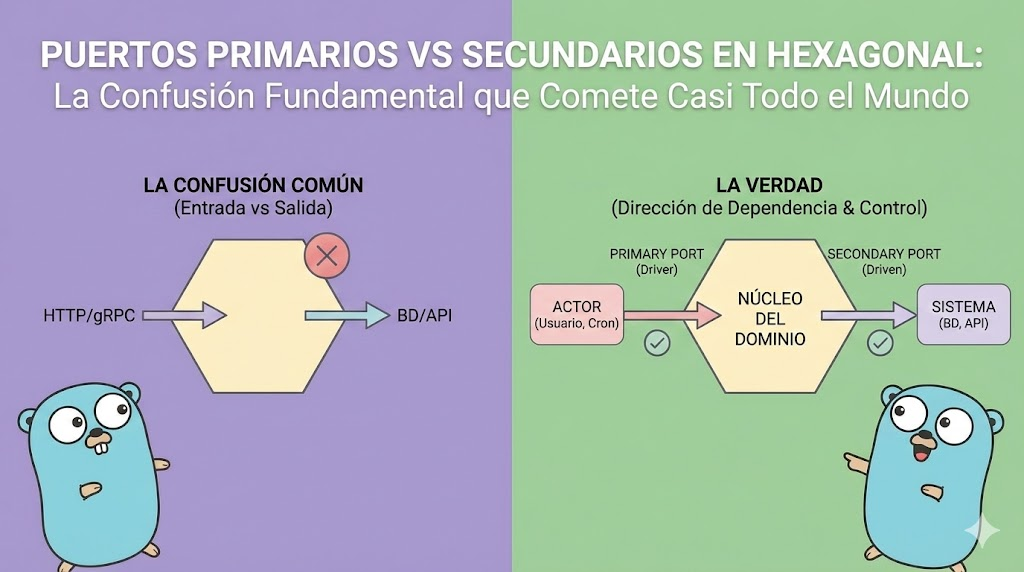
Puertos Primarios vs Secundarios en Hexagonal: La Confusión Fundamental que Comete Casi Todo el Mundo
Una guía exhaustiva sobre la verdadera diferencia entre puertos primarios y secundarios en arquitectura hexagonal, por qué casi todos lo entienden mal, y cómo implementarlos correctamente en Go. Con ejemplos, diagramas y patrones verificables.
API Versioning Strategies: Cómo Evolucionar APIs sin Romper Clientes
Una guía exhaustiva sobre estrategias de versionado de APIs: URL versioning vs Header versioning, cómo deprecar endpoints sin shock, migration patterns reales, handling de cambios backwards-incompatibles, y decisiones arquitectónicas que importan. Con 50+ ejemplos de código en Go.